Yale Forklift Service Manuals: Genuine Factory OEM Shop Manuals
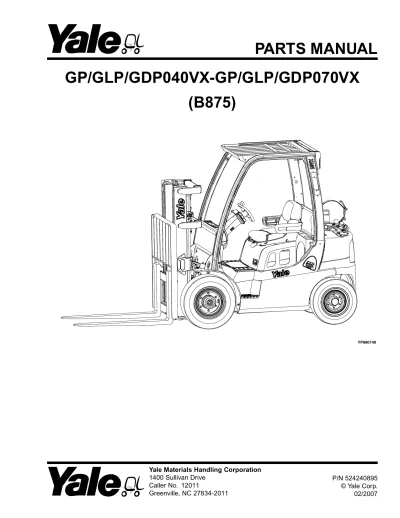
Get the exact technical data required to maintain the safety and performance of your Yale material handling equipment. This library provides high-resolution access to official factory specifications for hydraulic systems, electric motor diagnostics, and fleet maintenance across all Yale series, including Veracitor, GP-VX, and ERP models.
Authentic Manufacturer Documentation: The Real Factory Service Manuals
The quality of your repair is only as good as your data. Our collection consists exclusively of Genuine Factory Service Manuals. These are the exact digital reproductions of the official OEM literature used by master technicians at authorized Yale dealerships.
By using these direct-from-source records—rather than unreliable third-party reconstructions—you ensure that every wiring diagram, torque spec, and mechanical layout is 100% accurate. This eliminates guesswork and provides the verified manufacturer-level data needed to keep your lift trucks compliant with original build specifications.
Comprehensive Technical Specs & System Data
Our Yale library covers the specialized engineering of both modern and legacy lift trucks:
- Drive & Power Systems: Full calibration data for internal combustion engines (ICE) and electric AC/DC drive motors, including battery management (BMS) and ignition timing.
- Mast & Hydraulic Systems: Detailed schematics and pressure settings for lift, tilt, and auxiliary valves, with precise wear limits for masts, rollers, and chains.
- Electrical Architecture: Complete wiring layouts and controller pinout diagrams for troubleshooting load-sensing systems, electronic power steering (EPS), and CAN-bus networks.
- Mechanical Specifications: Factory-certified torque values, fluid capacities (ISO grades), and chassis alignment data to maintain long-term structural reliability.
Built for the Shop: Fast & Functional Access
These manuals are optimized for high-pressure workshop environments and delivered in high-fidelity, searchable PDF format.
- Instant Download: Access your technical files immediately after purchase to minimize equipment downtime and get your machines back in service.
- Field-Ready Compatibility: View manuals clearly on rugged tablets, smartphones, or laptops directly at the forklift or in the warehouse bay.
- Searchable Indexing: Quickly find specific Diagnostic Trouble Codes (DTC), component locations, or maintenance intervals using built-in keyword search.
- Print-Ready Quality: High-resolution schematics and tables remain crisp when printed, ensuring readability even in oily or rugged shop conditions.
Safety & Service Compliance
The Genuine Factory Service Manuals in this repository are professional-grade resources intended for trained mechanics and experienced technicians. Operating and repairing heavy material handling machinery carries inherent risks, particularly regarding high-pressure hydraulics, mast tension, and high-voltage systems. By downloading these materials, you acknowledge they are for technical guidance only. Always follow standard Lockout-Tagout (LOTO) procedures, use the correct diagnostic tools, and wear required PPE. If a procedure exceeds your technical expertise or equipment, consult a certified Yale service professional to ensure the safety of the operator and the facility.
Select your Yale model below to download the authoritative factory manual and maintain your fleet with manufacturer-level precision.
Yale Manuals (1 total results)