Ariel Service Manuals & Restoration Documentation
The Ariel name spans two vastly different eras of motoring history. Whether you are performing a concours-quality restoration on a vintage British motorcycle from the 1930s to 1950s (like the legendary Square Four or Red Hunter) or dialing in a modern, high-performance Ariel Atom for track day, the mechanical requirements are worlds apart. Having exact, era-specific technical documentation is the only way to ensure safety, authenticity, and peak performance.
Original Factory Data You Can Trust
Restoring a vintage classic or tuning a modern track weapon both demand absolute precision. Guessing the timing on a vintage Lucas magneto or using generic torque specs on an Atom’s exoskeleton chassis can lead to costly damage or dangerous failures. We don't rely on third-party guesswork. Our Ariel library consists of high-resolution, authenticated factory reproductions, giving you the exact wiring schematics, sensor calibrations, and assembly procedures established by Ariel’s original engineers.
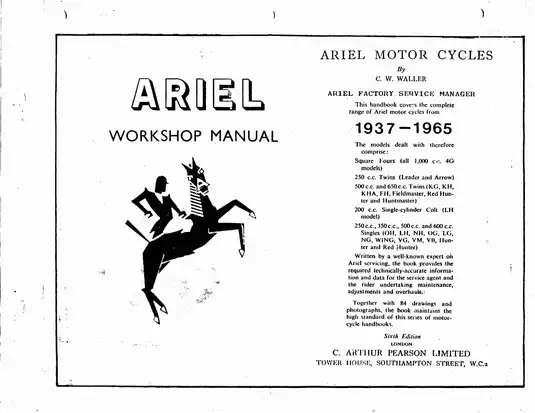
- OEM Factory Manuals: For modern vehicles, we supply unedited factory service data. For classic motorcycles, we provide high-resolution scans of the original Ariel Motors workshop books, parts lists, and historical service bulletins.
- Unaltered Specifications: Every critical metric—from exact valve timing and Amal carburetor jetting for vintage singles, to suspension geometry and engine management data for Honda-powered Atoms and Nomads—is exactly as the manufacturer published it.
- Workbench-Ready Clarity: We meticulously inspect every PDF. Faded historical wiring diagrams, intricate exploded views, and complex modern chassis schematics are crystal clear and easy to read right at your toolbox.
Finding the Right Ariel Manual
Because the brand covers everything from classic iron to modern supercars, verifying your exact vehicle specs is crucial before downloading:
- Classic Ariel Motorcycles (Pre-1970): Identify your exact engine configuration. The diagnostic approach for a 350cc or 500cc single is entirely different from the complex four-cylinder layout of the Square Four. Pay close attention to the production year, as wartime and post-war models feature distinct mechanical differences, particularly regarding Lucas electrical systems and front fork dampening (girder vs. telescopic).
- Modern Ariel Vehicles (Atom, Nomad): Ensure the documentation matches your specific chassis and powertrain. The Atom has utilized various Honda K-series engines (K20, K24) and supercharged variants across its iterations (Atom 2, 3, 3.5, 4). Your manual needs to align perfectly with your exact ECU mapping and setup.
Types of Documentation Available
Make sure you grab the right guide for your specific project:
- Workshop & Service Manuals: The go-to resource for heavy mechanical work. These provide step-by-step data for engine overhauls, gearbox rebuilds, and complete diagnostic teardowns.
- Spare Parts Lists: An absolute must-have for vintage restorations. These include original factory part numbers and exploded assembly diagrams, taking the guesswork out of sourcing NOS (New Old Stock) parts and ensuring authentic reassembly.
Ariel Manuals (1 total results)