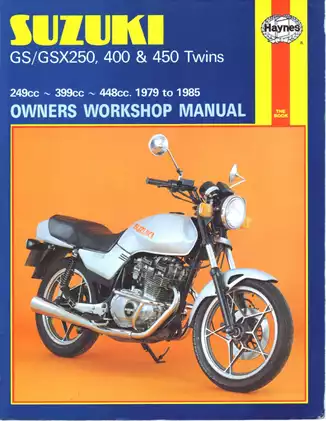
1979-1985 Suzuki GS/GSX 250, 400 & 450 Twins Repair Manual

Complete service and maintenance procedures for GS250T, GSX250E, GSX400E/T, and GS450 models. Covers engine, clutch, gearbox, fuel system, ignition, and chassis repairs with detailed specifications and torque settings.

4.5starstarstarstarstar_half(4)
visibility Preview Available
Suzuki 1979-1985 Suzuki GS/GSX 250, 400 & 450 Twins Repair Manual manual page preview - page 1 of 200
Sample pages from the 1979-1985 Suzuki GS/GSX 250, 400 & 450 Twins Repair Manual manual
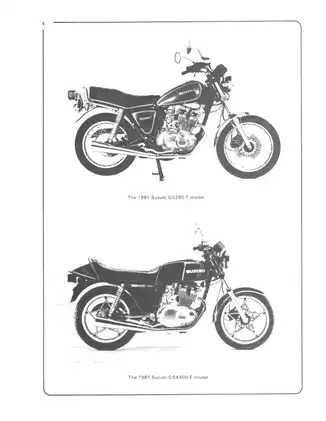
Suzuki 1979-1985 Suzuki GS/GSX 250, 400 & 450 Twins Repair Manual manual preview page 1 - thumbnail
Suzuki 1979-1985 Suzuki GS/GSX 250, 400 & 450 Twins Repair Manual manual preview page 2 - thumbnail
Suzuki 1979-1985 Suzuki GS/GSX 250, 400 & 450 Twins Repair Manual manual preview page 5 - thumbnail
info_outline Click thumbnails to preview different pages

Purchase & Download

$18.05 (incl. VAT) Instant Download / No Shipping Fees
2 sold in the last 30 days
OR BUY NOW
verified_user
Lifetime Access
Re-download anytime
flash_on
Instant Download
Get it immediately
lock
Secure Payment
PayPal

Document Details

keyboard_arrow_down
Document Number / Seller:
24351 / Kenneth Jones
File Size:
106.40 MB
File Type:
PDF
Language:
English
Pages:
200
Printable:
Yes
Category:
Motorcycle
Last updated / verified
Apr 30, 2025

Models Covered & Key Technical Specifications

Suzuki GS/GSX 250, 400 & 450 Twins — 1979–1985 Advanced Systematic Documentation | Suzuki GS Series Archive.

  • Verified Generation Capacity: 249 cc to 448 cc displacement is measured at the twin-cylinder air-cooled engine architecture Bounds.
  • Engineered Working Temperature: For optimal performance, 0.08–0.13 mm valve clearance (cold) represents the intake and exhaust valve tolerance Framework.
  • Prescribed Operational Speed: Maximum engine speed is established at 3500 + 100 rpm for ignition timing advance procedures Topology.
  • Nominal Addressable Resolution: The compression ratio is set to 10.5:1 (250 models) and 10.0:1 (400 models) for combustion chamber pressure Matrix.
  • Defined Reservoir Specs: Tank volume produces 11–14.5 L (2.4–3.8 Imp/US gal) total fuel capacity requirements Standards.
  • General Amperage Specs: Sparking plug gap is configured at 0.6–0.7 mm (0.024–0.028 in) for electrical ignition system operation Protocol.

Professional Workshop Service Manual & Technical Specifications

Definitive Service Diagnostic Manual: Motorcycle 1979-1985 Suzuki GS/GSX 250, 400 & 450 Twins - Maintenance, Diagnostics & Repair Manual Hydraulic-Guide

System-Identifier: GS250T, GSX250E, GSX250EZ, GSX400E, GSX400T, GS450E, GS450L, GS450S, GS450T, GS450TX // Design-Core: Twin-cylinder four-stroke air-cooled engine / Double overhead camshaft propulsion system Logic // System-Identifier: DOHC parallel twin 249-448cc capacity with constant mesh six-speed transmission.

Performance-Element Value Calibration-Standards
Engine Configuration Twin-cylinder DOHC four-stroke Documented across all covered models
Transmission Six-speed constant mesh gearbox Complete specifications provided
Ignition System Transistorised CDI with automatic timing unit Comprehensive timing data included
Fuel Delivery Dual Mikuni CV carburettors Float chamber fuel level reference documented
Lubrication Architecture Forced pressure wet sump system Oil pressure and capacity specifications included

Technical content addresses engine and transmission systems, fuel system components, ignition timing procedures, and cooling system maintenance. The manual encompasses clutch assembly operations, gearbox component examination, final drive chain adjustment, brake system servicing, electrical system configuration, and steering head bearing maintenance, with procedures covering spark plug maintenance, ignition synchronisation, carburettor adjustment, and oil filter renewal throughout the document.

Strategic Sequences

Methodically requiring attention to component specifications, the document includes torque specifications for engine mounting bolts, cylinder head fasteners, connecting rod caps, camshaft journal retaining bolts, and primary drive gear pinion nuts to ensure proper fastener fatigue prevention. The manual documents valve clearance reference data with cold-engine adjustment procedures, cam chain tensioner settings, and rocker arm configuration details for optimal valve train operation.

Precise Logic-Path

Technical notes are provided for counterbalance shaft examination, including bearing shell renewal criteria and shock absorber spring service limits across 250 and 400cc models. The gearbox section covers mainshaft and layshaft assembly sequences, selector fork clearance measurement, gear pinion groove width specifications, and bearing location half clip positioning procedures. Complete specifications are documented for crankshaft journal oil clearance, connecting rod big-end width tolerances, and thrust bearing thickness limits.

Modular Nexus

Quality checks are addressed for cylinder block bore wear measurement, piston ring groove clearance verification, piston-to-bore clearance determination, and cylinder head distortion limits using straight-edge and feeler gauge techniques. The document outlines camshaft bearing journal clearance assessment using plastigage strip methodology, cam lobe height verification, and camshaft runout measurement procedures with diagnostic limits for determining component renewal requirements.

Systematic Sequences

The troubleshooting chapter addresses engine seizure symptoms, excessive mechanical noise diagnosis, lubrication failure indicators, and performance degradation pattern recognition. Cooling system maintenance is addressed in sections covering air filter element cleaning intervals, element inspection for tears or hardening, and fuel system component examination including fuel tap diaphragm operation, carburettor float chamber gasket condition assessment, and pilot jet sizing reference data across multiple model variants and market regions.

FAQ

What **designated** tools are required for routine adjustment procedures? keyboard_arrow_down

3.0 - 5.0 ohms primary winding resistance is specified for ignition coil testing, requiring a multimeter capable of ohms measurement and a stroboscopic timing lamp for accurate ignition timing verification at both fixed and advancing RPM positions.

Identify the **critical** pressure specifications for engine operation. keyboard_arrow_down

3.0 — 5.5 kg/sq cm (42.7 — 78.2 psi) at 3000 rpm defines correct oil pressure when measured through the blanking plug located directly below the ignition pick-up assembly housing on the right-hand crankcase cover.

What procedures are **required** for proper camshaft timing during assembly sequence? keyboard_arrow_down

20° BTDC below 1650 rpm and 40° BTDC above 3500 rpm establish correct ignition timing marks, with the 'F' mark on the automatic timing unit requiring exact alignment with the index mark on the static plate for accurate valve timing during crankshaft rotation.

Customer Reviews

Read what our customers say about this Suzuki Motorcycle manual and share your own experience.

Add a Review

* Required information
1000
Captcha Image

Reviews (4)

Avatar
New
I found the manual to be thorough and well-organized. The email support was quick and professional when I needed help downloading it. Highly recommend!
Avatar
New
Rated 5 out of 5 stars
Avatar
New
This manual has been incredibly helpful for my GS250T. The step-by-step guides are easy to follow, and the detailed diagrams made repairs a breeze!
Avatar
New
The illustrations and detailed instructions make it simple for anyone to maintain their bike. I had a smooth download process, and the support team was very responsive!