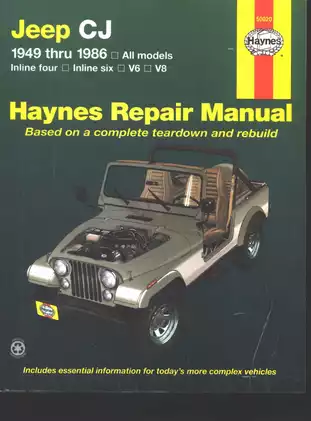
1949-1986 Jeep CJ Automotive Repair Manual

Covers all CJ models 1949-1986 including engines and transmissions. Complete factory repair procedures for inline four, six-cylinder, V6 and V8 engines with step-by-step illustrated instructions for engine work, clutch service, transmission repair and electrical systems throughout the full model year range.

5.0starstarstarstarstar(1)
visibility Preview Available
Jeep 1949-1986 Jeep CJ Automotive Repair Manual manual page preview - page 1 of
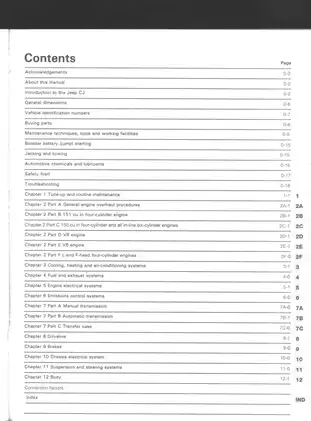
Sample pages from the 1949-1986 Jeep CJ Automotive Repair Manual manual
Jeep 1949-1986 Jeep CJ Automotive Repair Manual manual preview page 1 - thumbnail
Jeep 1949-1986 Jeep CJ Automotive Repair Manual manual preview page 2 - thumbnail
Jeep 1949-1986 Jeep CJ Automotive Repair Manual manual preview page 4 - thumbnail
Jeep 1949-1986 Jeep CJ Automotive Repair Manual manual preview page 5 - thumbnail
info_outline Click thumbnails to preview different pages

Purchase & Download

$17.45 (incl. VAT) Instant Download / No Shipping Fees
1 sold in the last 30 days
OR BUY NOW
verified_user
Lifetime Access
Re-download anytime
flash_on
Instant Download
Get it immediately
lock
Secure Payment
PayPal

Document Details

keyboard_arrow_down
Document Number / Seller:
24464 / Margaret Hicks
File Size:
61.74 MB
File Type:
PDF
Language:
English
Printable:
Yes
Category:
Off-Road Vehicle
Last updated / verified
Apr 17, 2025

Models Covered & Key Technical Specifications

Jeep CJ Series (CJ-2A, CJ-3A, CJ-3B, CJ-5, CJ-6, CJ-7, Scrambler) — 1949–1986 Consolidated Mechanical Documentation for CJ Toolkit.

  • Maximum Cold Start Limits: Engine cranking compression pressure reaches 120–130 psi (F- and L-head four-cylinder engines) — is established at the base mechanical Architecture.
  • Authorized Velocity Specs: Top engine speed on V8 models dictates 700 to 800 rpm curb idle setting for proper combustion chamber performance Norms.
  • Fundamental Enclosure Specs: Coolant system capacity corresponds to 12 US quarts (F- and L-head four-cylinder engine) with standard cooling loop Bounds.
  • Specific Fastener Specs: Cylinder head bolt torque values yield 92 ft-lbs (125 N·m) for the GM 151 cu in four-cylinder engine Framework requiring precision tightening Topology.
  • Critical Tolerance Values: Main bearing journal diameter reaches 2.2988 inches (58.378 mm) on the 151 cu in four-cylinder engine — is set to specification for crankshaft assembly Matrix.
  • Rated Thermal Rating: Valve spring pressure is set to 78–86 lbs at 1.66 inch installed length (151 cu in engine) — established closure specification for complete valve train Standards.

Professional Workshop Service Manual & Technical Specifications

Certified Training Wiring Manual: Off-Road Vehicle Jeep CJ-2A, CJ-3A, CJ-3B, Scrambler, CJ-5, CJ-5A, CJ-6, CJ-7, Renegade, Laredo, Golden Eagle 1949-1986 - Comprehensive Repair & Restoration Manual Chassis-Documentation

Technical-Domain: CJ-2A (1949-1953), CJ-3A (1953-1968), CJ-3B (1953-1968), Scrambler (1981-1985), CJ-5 (1954-1975), CJ-5A (1970s), CJ-6 (1965-1975), CJ-7 (1976-1986), Renegade (1970s-1980s), Laredo (1980s), Golden Eagle (1976-1986) // Coverage-Scope: Inline Four, Inline Six, V6, and V8 Engine Systems // Technical-Domain: 200-page manual with engine specifications, electrical components, and chassis systems.

Performance-Element Diagnostic-Logic Framework
Engine Overhaul Procedures General disassembly and reassembly specifications Complete procedures documented
Tune-Up and Routine Maintenance Service intervals and fluid specifications Documented for all model years
Transmission and Transfer Case Manual, automatic, and Quadra-Trac systems Component identification provided
Electrical System Components Battery, starter, alternator, and ignition timing Wiring locations and specifications included

Maintenance hierarchies are structured into tune-up sequence operations covering engine mechanical systems, fuel system diagnostics, cooling system servicing, brake component inspection, and suspension/steering verification procedures. The manual addresses engine electrical system components, cooling and heating apparatus documentation, fuel and exhaust system layouts, transmission operation specifications, transfer case mechanisms, driveline component identification, brake system architecture, and chassis electrical routing. These topics are supplemented by comprehensive troubleshooting references, general dimensions data, vehicle identification number procedures, and maintenance techniques documentation.

Diagnostic Architecture

Fundamentally requiring systematic inspection protocols, the service manual documents comprehensive engine mechanical systems encompassing F-head and L-head four-cylinder engines, the 151 cubic inch four-cylinder engine, 150 cubic inch four-cylinder engine, inline six-cylinder engines, V6 and V8 powerplants. Specifications include compression pressures, valve clearance measurements, ignition timing specifications, and curb idle speed settings. The document contains extensive cylinder head gasket surface warpage limits, valve margin width data, valve stem-to-guide clearance parameters, and valve spring pressure measurements at specified compression and open positions.

Systematic Benchmarks

Reassembly procedures are specified for piston/connecting rod assemblies with detailed bearing oil clearance verification protocols using Plastigage measurement methods. The manual provides professional module documentation for main bearing installation sequences, crankshaft journals preparation, piston ring installation procedures, and connecting rod cap fastener tightening sequences. Service intervals are documented for automatic and manual transmission fluid changes, differential lubricant replacement, transfer case servicing, and wheel bearing lubrication schedules. Component locations are identified for spark plug accessibility on V8, V6, and inline engine configurations, with specific routing instructions for spark plug wires and distributor cap connections.

Comprehensive Nexus

Service procedures are documented for timing gear cover removal and installation on 151 cubic inch four-cylinder engines, camshaft bearing replacement techniques, and oil pump disassembly and reassembly operations. The service manual includes crankshaft pulley hub extraction methods, front oil seal replacement procedures, and rear main oil seal installation specifications. Flywheel and driveplate identification procedures address both manual and automatic transmission applications, documenting ring gear inspection criteria and converter securing bolt hole assessment parameters.

Systematic Benchmarks

Calibration requirements are specified for carburetor mounting torque verification, engine idle speed adjustment procedures, and ignition timing check methodologies. The manual documents emissions control system component locations, exhaust heat valve operation verification, and EGR valve functionality assessment. Troubleshooting procedures encompass engine mechanical fault diagnosis, electrical system failure identification, fuel system malfunction diagnosis, cooling system performance evaluation, clutch mechanism problem-solving, manual transmission noise assessment, automatic transmission fluid leakage diagnosis, transfer case shift difficulty resolution, driveshaft vibration analysis, axle noise characterization, brake system problem determination, and suspension/steering system fault identification.

Operational Parameters

The document includes detailed exploded view illustrations of cylinder head components, engine lower end assemblies, oil pump and pan systems, and hydraulic valve lifter mechanisms. Specifications for torque values are documented for cylinder head bolts, main bearing cap bolts, connecting rod nuts, crankshaft pulley bolts, oil pan drain plugs, and oil pump mounting hardware. The manual documents torque specifications for the cylinder head bolts to ensure proper fastener fatigue prevention.

Comprehensive specifications cover general engine displacement data, bore and stroke measurements, compression ratio ratings, oil pressure operating ranges, and cylinder bore taper limits. The service manual provides piston and ring specifications including piston diameter measurements, piston-to-cylinder bore clearance parameters, piston ring side clearance data, and piston ring end gap measurements. Crankshaft and connecting rod specifications address main journal diameters, main bearing oil clearance values, connecting rod journal dimensions, connecting rod bearing oil clearance standards, and crankshaft end play measurements.

FAQ

What procedures are **necessary** to check the engine oil level and electrical connections? keyboard_arrow_down

5 minutes after engine shutdown is the proper interval for checking the dipstick to obtain accurate readings between the Add and Full marks. Battery-specific gravity of 1.260 to 1.265 (fully charged) must be verified, and all cable terminals require cleaning with a baking soda solution if corrosion appears.

Determine the **recommended** spark plug gap and torque specifications for installation. keyboard_arrow_down

0.035 inches is the standard gap setting for V6 engines, while 0.030 inches applies to four-cylinder engines. Tighten spark plugs to 25 to 35 foot-pounds using a torque wrench to ensure proper seating without thread damage.

What specifications are **calibrated** for the connecting rod bearing clearance and crankshaft journal measurements? keyboard_arrow_down

0.0005 inches standard clearance is required for the GM 151 cubic inch four-cylinder engine main journal diameter of 2.2988 inches, with a maximum taper limit of 0.0005 inches. Connecting rod journal diameter measures 2.000 inches with identical taper and out-of-round limits to maintain proper oil film thickness during operation.

Customer Reviews

Read what our customers say about this Jeep Off-Road Vehicle manual and share your own experience.

Add a Review

* Required information
1000
Captcha Image

Reviews (1)

Avatar
New
This manual is incredibly detailed and easy to follow. The troubleshooting guide saved me a ton of time! Plus, the download process was smooth and support was prompt when I had questions. Highly recommend!