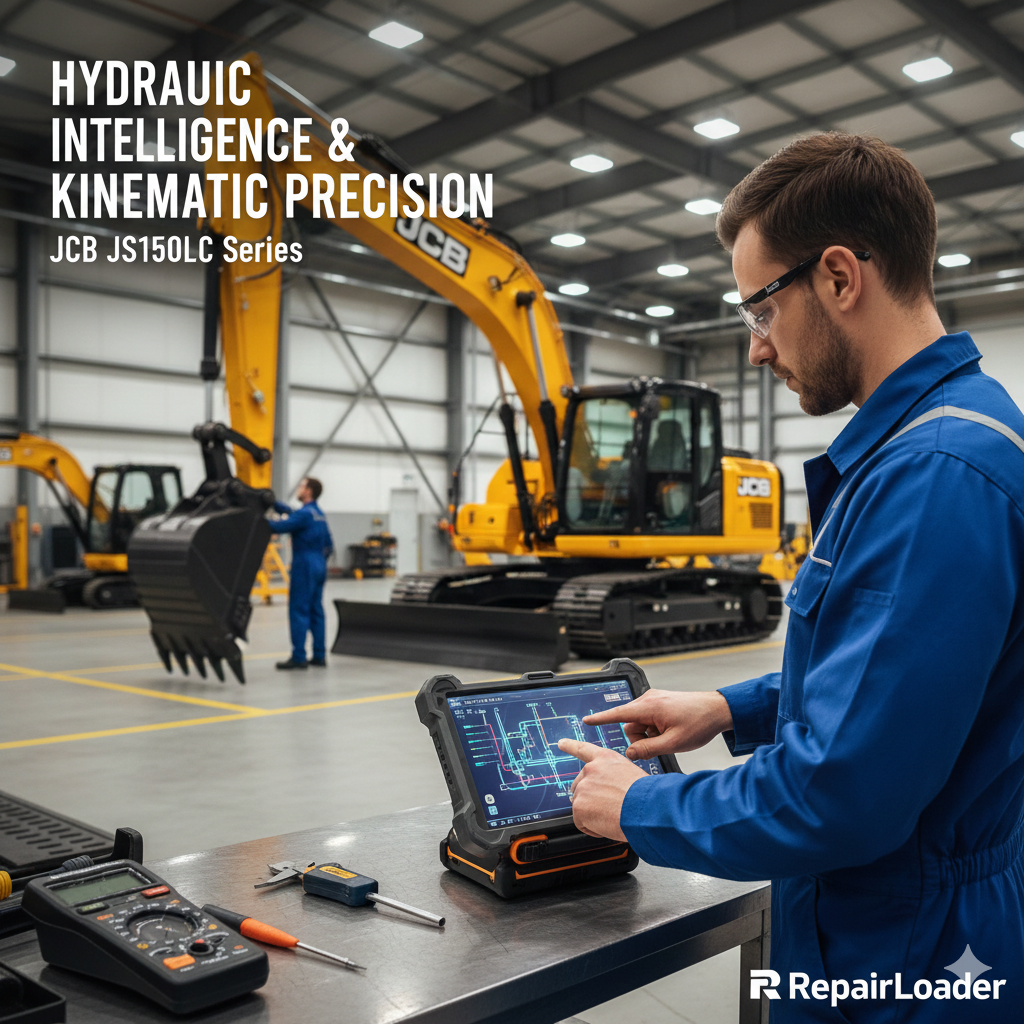
In the competitive landscape of heavy excavation, operational dominance is defined by the seamless integration of hydraulic flow and structural durability. For fleet managers and lead technicians, maintaining the JCB JS-series excavators (JS110, JS130, JS150LC) requires more than basic maintenance; it demands a surgical understanding of the machine’s internal architecture. To prevent parasitic power loss and ensure the longevity of the undercarriage, technical teams must rely on verified Factory Service Data to maintain manufacturer-specified tolerances.

The Architecture of High-Pressure Systems
The JCB JS-series is engineered around a sophisticated hydraulic logic designed to optimize cycle times while minimizing fuel consumption. Precision in this area is critical, as the interaction between the main control valves and the engine’s power output dictates the machine’s overall efficiency.
- Hydraulic Flow Mapping: A deep-level technical analysis involves the calibration of the variable displacement pumps. The documentation provides exhaustive schematics for the hydraulic circuits, including the pilot-signal manifolds and the secondary relief valve settings.
- Transmission and Track Logic: Maintaining the structural integrity of the running gear requires precise torque values for the final drives and track tensioning protocols. Understanding the kinematic relationship between the travel motors and the planetary gears is essential for heavy-duty earthmoving operations.
Comprehensive Technical Documentation: The JCB Master Archive
When facing complex diagnostic challenges, the quality of your technical intelligence determines the speed of recovery. This JCB JS110 JS130 JS150LC Service Manual provides the high-authority data necessary to navigate the internal systems of these specialized excavators.
This Technical Workshop Archive is a massive resource, delivered as a high-resolution PDF for instant mobile access on the job site. Spanning over 800 pages of technical intelligence, the manual includes:
- Illustrated Component Identification: Hundreds of exploded views for the engine (Section K), transmission (Section F), and hydraulics (Section E).
- Precision Torque Settings: Section 1-2 provides the exact manufacturer benchmarks for every critical fastener across the chassis.
- Electrical Diagnostics: Comprehensive wiring diagrams (Section C) to isolate faults within the monitoring systems and ECU interfacing.
Strategic Maintenance for Excavator Fleets
To remain competitive, service departments must move beyond reactive repairs and implement a proactive technical strategy. Leveraging original Master Service Data ensures that every overhaul—from the swing motor to the boom cylinder—meets the engineering standards set by the factory.
For professionals looking to expand their technical repository, we offer specialized access to our data hubs:
- Explore the full range of high-authority Excavator Technical Workshop Archives for various brands and models.
- Access the definitive JCB Factory Service Data portal for your entire fleet.
In addition to the JS-series documentation, technicians specialized in mid-range excavation often find that the JCB JS200 to JS260 Service Manual is an essential secondary resource for their technical library.
Conclusion: Data-Driven Performance and Structural Integrity
Maintaining a JCB excavator is an investment in industrial productivity. The structural integrity of the body and framework, combined with the precision of the hydraulic logic, requires a data-driven approach to servicing. By utilizing verified Technical Manual Specifications, you eliminate technical uncertainty and protect the long-term ROI of your machinery. Whether you are performing a mid-season hydraulic pressure test or a complete engine overhaul, the RepairLoader repository delivers the verified source information required to keep your fleet at peak performance in the most demanding environments.