Choosing the right chainsaw manual is rarely as simple as picking a brand and clicking the first result. Many saw families share similar naming, some listings cover several closely related models, and not every document serves the same purpose. That is exactly why the RepairLoader chainsaw category is useful as a starting point. It gives buyers a broader view first, so they can compare model groups, document types, and scope before moving into a more specific product page.
That broader view matters because the chainsaw section is not built around one narrow type of file. Buyers will find service manuals, workshop manuals, technical manuals, and parts-list-style documents. In practical terms, that means the first decision is often not just which brand you own, but what kind of documentation you actually need. A technical manual covering a larger John Deere family serves a different purpose from a STIHL service manual focused on one model line, and both differ again from a Jonsered spare parts list meant primarily for component identification.
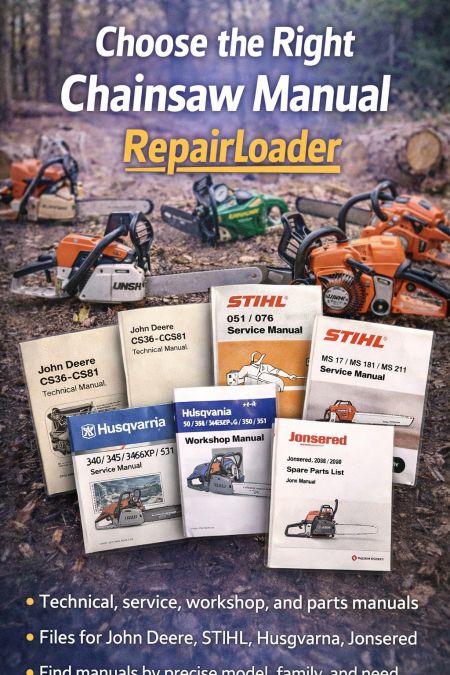
The main chainsaw category page is the best place to start when you still need orientation. If you know your machine is a chainsaw but you are not yet sure whether your safest match is a broad family manual, a tight model-specific service file, or a parts-focused document, the category helps you compare those paths quickly. It is especially useful when several titles look similar at first glance but are actually grouped around very different chainsaw families.
The linked product pages show why that comparison step matters. The John Deere CS36, CS40, CS46, CS52, CS56, CS62, CS71, CS81 technical manual is a strong example of a broader family-style listing. It makes sense when your first reliable identifier is the CS-series family and you want one manual that covers several nearby models instead of just one narrow unit. That can be a smart starting point if you already know the machine is in the CS line but still need to confirm the exact number printed on the saw.
The STIHL 051 / 076 service manual fits a different buying pattern. It is better for users who already know they are working inside that older STIHL family and want a tighter service-focused reference instead of a broad brand search. The same model-first logic applies to the STIHL MS 261 service manual and the STIHL MS 171 / MS 181 / MS 211 service manual. These pages are most useful when the exact model code on the saw is already known, because the safest buying signal is the full model designation, not just “STIHL chainsaw.”
That distinction is especially important with STIHL because nearby model names can still point to different engine sizes, generations, and coverage boundaries. A buyer choosing between MS 171, MS 181, MS 211, and MS 261 should not treat those as interchangeable just because they share the same brand. On pages like these, the more precisely the title matches the machine badge, the safer the purchase usually is.
The Husqvarna listings show another common selection pattern. The Husqvarna 50 / 50 Special / 51 / 55 service manual is useful when the machine belongs to an older grouped family and the listing is clearly built around that cluster rather than a single standalone model. The Husqvarna 340 / 345 / 346XP-G / 350 / 351 workshop manual is broader still, and it is a good example of when a grouped workshop manual can help buyers comparing several nearby Husqvarna models at once. If your saw is definitely in that family but you are still confirming the exact number, a grouped manual like this can be the right page to examine first.
The Jonsered 2036 / 2040 spare parts list adds another useful contrast because it is not framed the same way as the service and workshop manuals. This kind of listing is especially relevant when the buyer needs parts identification, assemblies, and model-linked component breakdowns more than a broader service-style document. That is a good reminder that “manual” can mean different things on a chainsaw page, and choosing the wrong document type can lead to disappointment even when the brand and model look correct.
A practical way to avoid the wrong purchase is to let the title wording do more work for you. If a listing says “technical manual,” it may be broader and more family-oriented. If it says “service manual” or “workshop manual,” it usually points to a more repair- and specification-focused reference. If it says “spare parts list,” it is often the better match for buyers who mainly need parts breakdowns and identification. Those document-type differences matter just as much as the brand name.
The second key buying signal is the exact model code. On RepairLoader’s chainsaw pages, a title that clearly names CS56, MS 261, 051, 076, 346XP-G, or Jonsered 2040 is giving you far more useful guidance than a generic “chainsaw manual” label. Always compare the full badge on your saw to the full wording in the listing title. Small differences in numbers or suffixes can mean a different family, a different generation, or a different level of coverage.
Another helpful habit is to compare scope before price. A cheaper listing is not necessarily the better buy if it stays vague while another one clearly names the exact chainsaw family or document type. Preview availability can also help, especially when a seller offers sample pages. Even a quick preview can make it easier to tell whether you are looking at a family-level technical reference, a service-oriented manual, or a parts-focused file.
What users will find across these pages is not just a group of downloadable chainsaw PDFs, but a better way to choose between them. Start with the main chainsaw category when you need orientation across brands and document types. Move to the John Deere CS-series manual when your saw is in that broader CS family. Use the STIHL 051 / 076 manual, STIHL MS 261 manual, or STIHL MS 171 / 181 / 211 manual when you already know the exact STIHL model. Turn to the Husqvarna 50 / 51 / 55 family manual or the Husqvarna 340 / 345 / 346XP-G / 350 / 351 workshop manual when grouped Husqvarna coverage is the better match. And use the Jonsered 2036 / 2040 parts list when parts identification is the priority.
That is what makes this section useful for shoppers. It does more than display chainsaw manuals. It helps buyers choose by real decision signals: exact model code, grouped family coverage, and document type. For anyone trying to find the right chainsaw manual online without wasting time on vague or only partly matching listings, RepairLoader’s chainsaw section is a practical place to start.