The BMW E39 rewards careful work: tight packaging, lots of fasteners with specific torque requirements, and systems that don’t forgive shortcuts. If you’re planning repairs on a 1997–2002 BMW 5 Series (E39)—including 525i, 528i, 530i, 540i in sedan or sport wagon form—having the right reference material and a smart workflow matters as much as the tools.
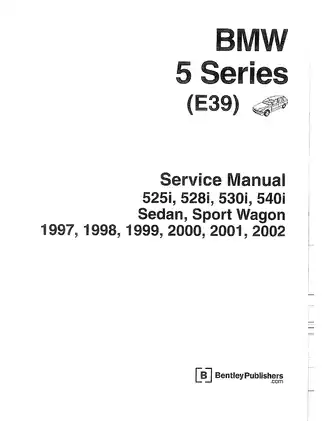
If you want the complete E39 service manual this article is based on, you can get it here: BMW 5 Series (E39) Service Manual download.
1) Safety first — the E39 has real hazards
Before any repair, treat the basics as non-negotiable:
- Ventilation is mandatory any time the engine runs—exhaust fumes can be lethal.
- Disconnect the battery negative terminal when you’re working on fuel or electrical systems.
- Airbags/seat belt tensioners (SRS) are explosive devices and must be handled with proper precautions.
- Fluids (fuel, coolant, brake fluid) need proper containers and cleanup discipline—both for fire safety and for health/environmental reasons.
A lot of “mystery problems” happen because someone skipped a safety step (or rushed a disassembly with pressure still in a line).
2) Confirm the exact car you’re working on: model year and VIN decoding
BMW E39 coverage spans multiple years and drivetrain variations, so it’s worth verifying the exact vehicle identity before ordering parts or diving into procedures. The E39 VIN is 17 characters, and the 10th character indicates the model year code.
Why that matters: even within the same nameplate (like “528i”), BMW made running changes. A correct VIN read helps you avoid mismatched parts, wrong specs, or chasing a fault using the wrong diagram set.
3) Tools that actually make E39 repairs go smoothly
You can do a lot with standard metric tools, but E39 work is faster and cleaner when you plan for:
- A solid metric socket and wrench set
- Torx drivers and bits (BMW uses Torx extensively)
- A torque wrench (BMW specs are about clamp load, not “feel”)
- A digital multimeter for electrical checks
- Proper jack stands—not optional if you’re under the car
For deeper engine, cooling, suspension, or drivetrain work, you’ll encounter procedures that reference BMW special tools—not always mandatory, but often the difference between a controlled job and a struggle.
4) Lifting and supporting the car: avoid the worst day
A huge number of DIY injuries come from unstable lifting. A jack is for lifting; stands are for supporting.
A safe pattern looks like this:
- Flat, solid ground
- Controlled lift
- Stands placed correctly
- The vehicle settled onto the stands and checked for stability before you work beneath it
If you’re doing brakes, suspension, exhaust, or driveline work, stable support is the foundation of the entire job.
5) Fasteners, seals, and “one-time-use” hardware (BMW means it)
BMW uses hardware designed for specific load and reuse rules. Some fasteners should not be reused once removed—especially self-locking fasteners and certain stretch-type bolts.
Also:
- Gaskets generally shouldn’t be reused if you want leak-free results.
- Some seals are directional, and installing them backward can cause immediate leaks.
- Torque matters—tightening evenly and in sequence prevents distortion and sealing issues.
6) Electrical diagnosis: understand the circuit before replacing parts
The E39 electrical system is logical, but you need a basic circuit mindset:
- Current flows only in a complete circuit (power + ground path).
- Many issues come down to a switch, connector, ground, or harness section—not the expensive module.
When wiring repairs are necessary, make them durable (proper connectors, proper insulation, and avoiding weak “twist-and-tape” fixes).
If you’re browsing E39-related options beyond a single listing, you can explore the broader car manual catalog here: Car manuals section, or go straight to BMW listings here: BMW manuals category.
7) What’s inside a full E39 repair reference (and why it helps)
A complete E39 service manual typically spans the entire vehicle:
- General warnings/cautions, vehicle identification
- Maintenance schedules and service items
- Engine systems (cooling, fuel injection, lubrication, exhaust)
- Transmission (manual/automatic) and driveline
- Suspension/steering/brakes
- Body and interior equipment
- Electrical systems, component locations, and wiring diagrams
- OBD/diagnostics reference
That breadth matters because real repairs often cross boundaries (example: a cooling issue becomes an electrical fan control issue; a drivability complaint touches fuel + ignition + sensors).
Keep exploring related manuals
If you’re comparing similar references or building a shortlist, here are a few more manual listings to check out: