1985-1998 Honda VT1100C/C2/T Shadow Spirit, American Classic Edition, and Tourer Motorcycle Owners Workshop Manual
Get your Honda VT1100 Shadow running smoothly with this comprehensive Owners Workshop Manual. Covers all models, including Spirit, ACE, and Tourer, with detailed procedures. Part No. 2313.
Manual Preview
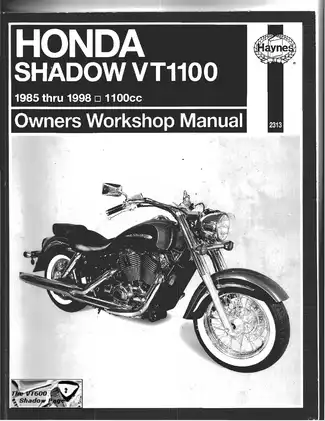
Sample pages from the 1985-1998 Honda VT1100C/C2/T Shadow Spirit, American Classic Edition, and Tourer Motorcycle Owners Workshop Manual manual
Purchase & Download
Honda Models Covered & Key Technical Specifications
Models: Honda VT1100C Shadow, Honda VT1100C2 Shadow American Classic Edition, Honda VT1100C Shadow Spirit, Honda VT1100T Shadow American Classic Edition Tourer
Sub-models / Variants: 1099 cc V-twin, liquid-cooled, 4-speed and 5-speed manual, California emissions variants
Build Years: 1985–1998
Serial Numbers: SC180, SC181, GA100, HA200, JA300, KA400, LA500, NA600, PA600, TA000, SA900, SC320, SC321, SC323, SC324, VA200
Technical Data:
- Engine: Liquid-cooled, SOHC, 4-stroke V-twin, 1099 cc displacement
- Transmission: 4-speed or 5-speed constant-mesh
- Compression Ratio: 8.0:1, 8.5:1, or 9.0:1 (model dependent)
- Carburetion: Twin 36 mm Keihin CV
- Spark Plug: NGK DPR7EA-9 or ND X22EPR-U9
- Engine Oil Capacity: 2.9 to 3.5 liters (viscosity SAE 10W-40 recommended)
- Coolant Capacity: 1.86 to 2.0 liters
- Final Drive: Shaft drive, gear-driven system
Honda Manual Features & Content Preview
Honda Shadow VT1100 1985–1998 Technical Documentation
- Covers 1985–1998 Honda VT1100C Shadow, VT1100C2 American Classic Edition, VT1100C Shadow Spirit, and VT1100T American Classic Edition Tourer with 1099 cc V-twin engine
- Haynes Publishing official publication P/N 2313, 1999 edition
- Contains 227 pages of specifications, wiring schematics, routine maintenance intervals, and exploded-view system diagrams
- Delivered as a direct download the moment payment clears
- Indexed PDF search covers every chapter and appendix
- Re-download the file any time, no expiration
- This 1999 edition is the definitive Haynes record for the 1985–1998 Honda VT1100 series, including the transition to American Classic Edition and Tourer variants
Engine and Maintenance Overview
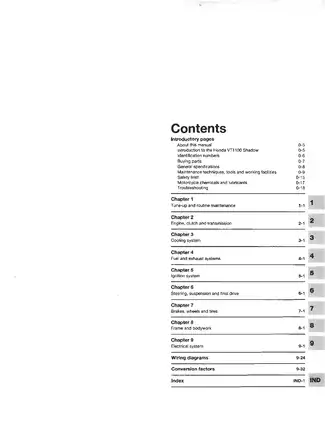
The 1985–1998 Honda VT1100 service manual provides technical insight into the liquid-cooled V-twin cruiser platform. This document outlines general maintenance procedures, including valve clearance checks, carburetor synchronization, and cooling system flushing. Chapters detail internal engine service such as cylinder head removal, piston ring replacement, and cam chain adjustment, alongside instructions for managing the hydraulic clutch and shaft-drive transmission systems.
Additional sections focus on frame and bodywork maintenance, electrical troubleshooting, and brake system care. The technical data provided in what an OEM service publication covers includes torque specifications for engine cover bolts, fuel tank capacities, and tire pressure guidelines.
Specification Highlights
Engine oil drain plug torque is documented at 30 Nm (22 ft-lbs) in the specification tables. Cooling system capacity for the 1995 and later VT1100C2 is documented at 2.0 liters. Intake valve seat width standard is specified at 0.90–1.10 mm. Cylinder head warpage limit is set at 0.05 mm across the entire cylinder head surface. Spark plug gap is specified at 0.8–0.9 mm for consistent ignition performance. The Honda VT1100 series cooling system uses a 50/50 mixture of ethylene glycol-based antifreeze and distilled water.
Reference only — always consult a certified technician before performing service on this equipment. This Haynes workshop manual serves as a technical reference for the 1985–1998 Honda VT1100 Shadow series, covering engine, chassis, electrical, and transmission specifications for the VT1100C, C2, and T variants.
Manual FAQ, Purchase & Download Details
Customer Reviews
Read what our customers say about this Honda Motorcycle manual and share your own experience.