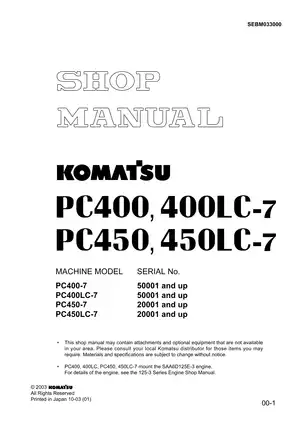
In the demanding sector of high-capacity earthmoving and structural demolition, the Komatsu PC400 and PC450 Series (including LC-7 variants) represent a pinnacle of hydraulic power and structural durability. Maintaining these massive platforms requires a disciplined adherence to factory-grade engineering benchmarks to ensure peak performance under extreme cycle loads. For specialized technicians and fleet managers, the primary requirement for sustaining high-uptime operations is the integration of verified technical data. Accessing the Komatsu PC400 and PC450 Service Manual is the definitive step toward ensuring that every procedure—from the synchronization of the main control valve to the calibration of the SAA6D125E-3 engine—aligns with the original manufacturer specifications.
The Kinematics of High-Pressure Hydraulics and Electronic Control
Modern excavator systems rely on advanced Closed-center Load Sensing Systems (CLSS) that must provide seamless multifunction control while managing consistent oil flow. The precision interface of the hydraulic pump and the electronic sensor network is particularly critical, where internal feedback loops manage the output based on real-time load demands.
A forensic look at Komatsu engineering reveals that maintaining hydraulic stability requires exact monitoring of the air cleaner clogging sensors and fuel level sensor thresholds. The PC400-7 and PC450-7 series utilize a robust diagnostic network where every electrical circuit, from the air conditioner to the main controller (Section 90-1), must be validated against factory wiring diagrams to prevent catastrophic electrical or hydraulic failure.
Structural Integrity and Power Unit Logic: SAA6D125E-3 Standards
The SAA6D125E-3 engine powering these units is engineered for continuous duty under variable thermal loads. A forensic look at the machine structure reveals that long-term reliability is dictated by the precise calibration of the cooling systems and the maintenance of the main frame and revolving frame integrity.
Critical Technical Calibration Benchmarks:
- Hydraulic Circuit Testing: Systematic validation of the pressure-relief thresholds to safeguard the boom and arm cylinders.
- Electrical Diagnostics: Verifying sensor terminals (Section 10-200) to ensure the thermistor and diaphragm components provide accurate feedback.
- Torque Values: Strict adherence to the Master Shop Manual torque values for all heavy-duty track-frame and swing-circle mounting points.
For professional organizations aiming to scale their technical capabilities in heavy excavation repair, utilizing our PC400-6 Series Technical Archive or the PC400-8 Master Service Data provides the specific factory data required for high-level fleet management.
Strategic Maintenance for Mining and Construction Portfolios
The service life of premium heavy equipment is extended only through a maintenance culture that rejects generic repair shortcuts. Our Komatsu PC200-8 Diagnostic Library and the PC1250 Series Overhaul Guide serve as centralized repositories for technical workshop archives, allowing for cross-model data verification and the maintenance of rigorous engineering standards across various tonnage platforms.
Conclusion: Sustaining Mechanical Sovereignty
The return on investment for the Komatsu PC400 and PC450 is protected by the quality of its technical care. By bypassing unverified secondary information and relying on the official Technical Workshop Archive, you secure the mechanical longevity and operator safety of your heavy equipment. True performance optimization is achieved only when the original engineering standards are treated as the absolute law of the workshop.