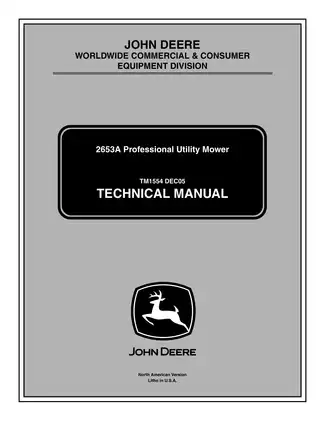
In the specialized field of golf course maintenance and professional turf management, the John Deere 2653A Professional Utility Mower represents a pinnacle of hydraulic precision and mechanical reliability. Maintaining the equilibrium between the liquid-cooled diesel power unit and the complex hydrostatic drive system requires disciplined adherence to factory-grade mechanical benchmarks. For professional technicians and groundskeepers, the primary requirement for sustaining high-uptime operations is the integration of verified technical data. Accessing the John Deere 2653A Technical Manual is the definitive step toward ensuring that every procedure—from the synchronization of the reel-to-bedknife clearance to the calibration of the transmission neutral creep—aligns with the original manufacturer specifications.
The Kinematics of Hydrostatic Drive and Hydraulic Steering
Modern mower systems rely on advanced hydraulic circuits that must maintain constant system pressure while adapting to variable terrain. The precision interface of the hydrostatic pump and the steering valve logic is particularly critical, where internal tolerances are measured in microns to ensure responsive control.
A forensic look at John Deere engineering reveals that maintaining mechanical sovereignty requires exact monitoring of the hydraulic relief thresholds. The 2653A utilizes a pilot-controlled system where flow rates must be validated against factory delivery curves to prevent cavitation and ensure stoichiometric efficiency in power delivery under heavy mowing loads.
Power Unit Logic and Transmission Calibration
Overhauling the 2653A powertrain involves more than standard component replacement; it requires validating the mechanical integrity of the planetary gear reduction and the thermal regulation of the cooling circuit.
Critical Technical Calibration Benchmarks:
- Transmission Neutral Creep: Precise adjustment of the control linkages to ensure operator safety and prevent unwanted machine movement (Section 292).
- Hydraulic Pressure Relief: Verification of the system thresholds to safeguard the lift and mow valve assemblies (Section 349).
- Fastener Integrity: Strict adherence to Grade 7 and metric torque values for all structural chassis components.
For professional organizations aiming to scale their technical capabilities, utilizing our John Deere 1400 Series Technical Archive or the 300 and 400 Series Master Service Data provides the specific factory data required for high-level fleet management.
Strategic Maintenance for Professional Turf Portfolios
The service life of premium turf equipment is extended only through a maintenance culture that rejects generic repair shortcuts. Our Hydrostatic Transmission Overhaul Guide serves as a centralized vault for technical workshop archives, allowing for cross-model data verification and the maintenance of rigorous engineering standards across various professional platforms.
Conclusion: Sustaining Mechanical Sovereignty
The return on investment for the John Deere 2653A is protected by the quality of its technical care. By bypassing unverified secondary information and relying on the official Technical Workshop Archive, you secure the mechanical longevity and operator safety of your machinery. True performance optimization is achieved only when the original engineering standards are treated as the absolute law of the workshop.