In the competitive landscape of all-terrain vehicle engineering, the Kawasaki KSF250 Mojave represents a significant milestone in DOHC (Double Overhead Camshaft) 4-valve engine architecture. Maintaining the equilibrium between the liquid-cooled power unit and the high-speed drivetrain requires disciplined adherence to factory-grade mechanical benchmarks. For professional technicians and performance enthusiasts, the primary requirement for sustaining peak operational efficiency is the integration of verified technical data. Accessing the Kawasaki KSF250 Mojave Service Manual is the definitive step toward ensuring that every procedure—from valve clearance synchronization to clutch plate measurement—aligns with the original manufacturer specifications.
The Kinematics of DOHC 4-Valve Systems and Cooling Efficiency
Modern ATV engines, particularly high-revving platforms like the Mojave, rely on sophisticated top-end designs that must maintain precise timing while managing significant thermal stress. The precision interface between the dual camshafts and the four-valve assembly is critical, where internal clearances must be measured with extreme accuracy to prevent volumetric efficiency loss or catastrophic valve-to-piston contact.
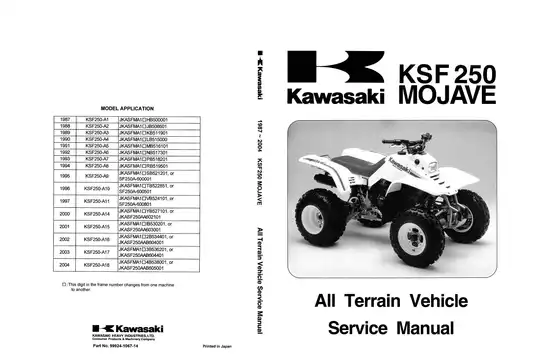
A forensic look at Kawasaki engineering reveals that maintaining “crisp” throttle response requires exact fuel system calibration and cooling system integrity. The KSF250 utilizes a liquid-cooling network where pump flow rates and thermostat opening thresholds must be validated against factory delivery curves to ensure stoichiometric stability under high-load racing or utility conditions.
Power Train Calibration and Transmission Integrity
Overhauling the Mojave drivetrain involves more than standard lubricant changes; it requires validating the mechanical integrity of the transmission gears and the thermal regulation of the lubrication circuit.
Critical Technical Calibration Benchmarks:
- Clutch Synchronization: Verification of the friction plate thickness and spring tension to prevent power loss during high-torque shifting.
- Crankshaft Alignment: Precise adjustment and inspection of the crank assembly to ensure minimal vibration and rotational balance.
- Electrical Diagnostics: Strict adherence to the wiring diagrams and terminal output values for the ignition and charging circuits (Section 15).
For professional organizations aiming to scale their technical capabilities in power sports repair, utilizing our Kawasaki KLF220 Technical Archive or the Bayou 250 Master Service Data provides the specific factory data required for high-level equipment management.

Strategic Maintenance for Power Sports Portfolios
The service life of premium off-road equipment is extended only through a maintenance culture that rejects generic repair shortcuts. Our technical archives serve as centralized vaults for workshop data, allowing for cross-model verification and the maintenance of rigorous engineering standards across various Kawasaki platforms, ensuring that the original engineering standards are treated as the absolute law of the workshop.
Conclusion: Sustaining Mechanical Sovereignty
The return on investment for the Kawasaki KSF250 Mojave is protected by the quality of its technical care. By bypassing unverified secondary information and relying on the official Technical Workshop Archive, you secure the mechanical longevity and operator safety of your vehicle. True performance optimization is achieved only when the original engineering standards are treated as the absolute law of the workshop.