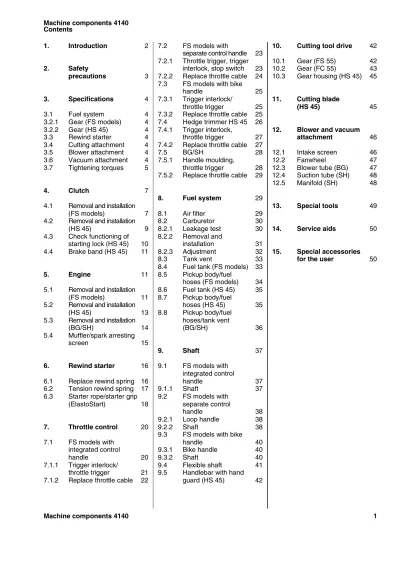
Factory Brushcutter Service Manuals: Heavy-Duty Trimmer & Clearing Saw Guides
Professional brushcutters and clearing saws are high-torque instruments engineered to manage dense vegetation, woody brush, and small saplings. Unlike light-duty string trimmers, these machines utilize heavy metal blades and operate under significant mechanical stress and high RPMs. Because brands like Stihl, Husqvarna, Echo, and Kawasaki utilize specialized centrifugal clutches, precision bevel gears, and complex two-stroke or hybrid four-stroke engines, generalized repair advice is insufficient. Accessing exact, model-specific factory documentation is the only way to ensure operator safety and tool longevity.
Technical Safety Notice: These professional-grade engineering archives are intended for landscape contractors and specialized forest mechanics. Servicing high-RPM clearing equipment and high-compression engines involves inherent operational risks. By utilizing these resources, you acknowledge that RepairLoader provides primary manufacturer data for informational and diagnostic purposes. Always prioritize safety: use the correct specialized tools, wear full PPE, and consult a factory-authorized technician if you are uncertain of any high-speed mechanical procedure.
Professional Vegetation Management: Verified Industrial-Source Digitalizations
In the high-stakes environment of forestry and commercial landscaping, the authenticity of your technical source material is the primary determinant of machine uptime and field safety. To meet the rigorous E-E-A-T standards for technical reliability, our brushcutter library consists of high-resolution, unaltered industrial-source digitalizations. Unlike generic third-party guides that lack specific carburetor jetting nuances, these digital volumes are 1:1 mirrors of the engineering data established by the original equipment manufacturer (OEM) R&D departments.
Engineered Reliability & Primary-Tier Dealership Archives
In forestry and professional landscaping, equipment failure in the field is costly and potentially dangerous. Using unverified third-party data to tune a carburetor or guessing the torque specifications for a brushcutter's blade mounting nut can lead to engine seizure or catastrophic blade detachment. To ensure your maintenance meets the rigorous standards of the industry, our repository is built exclusively on primary-tier dealership archives:
- Official Workshop Documentation: We provide high-resolution, unedited digital copies of the original factory repair manuals, shop guides, and official Technical Service Bulletins (TSB).
- Manufacturer-Specified Metrics: Every critical data point—from exact carburetor "L" and "H" needle settings and magneto air gaps to precise fuel-to-oil ratios and valve clearances—remains exactly as recorded in the original master reference files.
- Guaranteed Diagnostic Clarity: Every PDF is meticulously inspected to ensure that intricate fuel system schematics, ignition timing charts (M-Tronic/AutoTune), and exploded gear-head views are perfectly clear and usable right at your workbench.
How to Locate the Correct Brushcutter Manual
Brushcutters are categorized by their engine displacement and drive-shaft configuration. To ensure you download the correct technical literature, verify the following details on your equipment’s identification plate before making a selection:
- Identify the Engine Displacement and Type: Brushcutters range from light 25cc units to heavy-duty 50cc+ clearing saws. Crucially, identify if your machine uses a standard 2-stroke engine or a high-efficiency 4-stroke variant (such as the Honda GX series or Makita MM4). Each requires fundamentally different lubrication and valve maintenance.
- Match the Specific Model and Series Number: Manufacturers often produce multiple versions of a model (e.g., "T" for trimmer version vs. "W" for brushcutter version). Ensure the manual corresponds to your exact alphanumeric model code to guarantee compatibility with your drive shaft and gearbox.
- Verify Ignition and Fuel Systems: Older models with mechanical points require different diagnostic steps than modern units with electronic ignition modules and digital engine management (e.g., Husqvarna AutoTune). Always match your machine's production era to the manual's stated coverage.
Selecting the Right Documentation for Your Tool
Ensure the guide you choose matches the technical depth of your repair or maintenance task:
- Service & Workshop Manuals: The definitive references for deep mechanical repair, covering complete engine teardowns, crankcase pressure testing, and bevel gear overhauls.
- Illustrated Parts Lists (IPL): Vital for identifying exact OEM part numbers through exploded assembly diagrams, making it simple to source certified replacement carburetors, pistons, or drive shafts.
Brushcutter Manuals (4 total results)
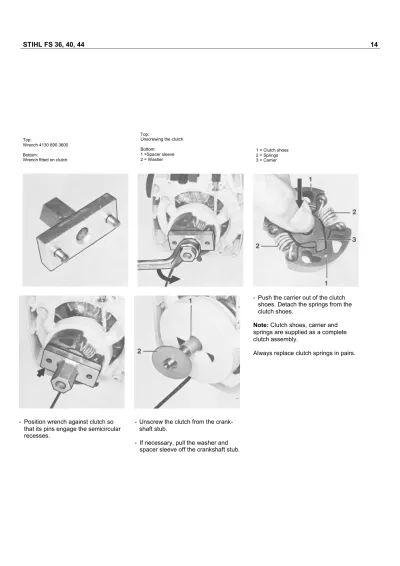
1994–2004 Stihl FS 36, FS 40 & FS 44 Brushcutter Service Manual with Parts List
Stihl FS 160, 180, 220, 280 Clearing Saw 1989–2004 Service Manual (P/N 0000 961 0608)
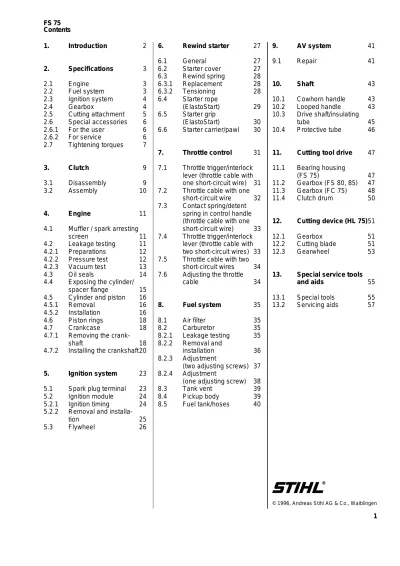
STIHL FS 75, FS 80, FS 85 Brushcutter 1996–2004 Service Manual