2006–2010 Suzuki GSR600 Service Manual (P/N 99500-36160-01E)
480 Pages • 51.01 MB • Instant, Printable PDF
Suzuki Models Covered & Key Technical Specifications
Models: GSR600, GSR600UE
Sub-models / Variants: K6
Model Years: 2006–2010 (2006, 2007, 2008, 2009, 2010)
Serial Numbers: JS1B9111100 100001–, JS1B9111300 100001–, JS1B9121100 100001–
-
Engine type: Four-stroke, liquid-cooled, DOHC, 4-cylinder
-
Engine displacement: 599 cm³
-
Bore x Stroke: 67.0 mm x 42.5 mm
-
Compression ratio: 12.5:1
-
Transmission: 6-speed constant mesh
-
Engine oil capacity (oil change): 3.2 L
-
Engine coolant capacity (total): 2.8 L
-
Idle speed: 1300 ± 100 r/min
-
Spark plug gap: 0.7 – 0.8 mm
-
Valve clearance (cold) Intake: 0.10 – 0.20 mm
-
Valve clearance (cold) Exhaust: 0.20 – 0.30 mm
-
Rear axle nut torque: 100 N·m
Suzuki Manual Features & Content Preview
- Details the 2006–2010 Suzuki GSR600 and GSR600UE sport motorcycles, covering K6 model-year configurations and variant-specific frame numbering sequences.
- Official Suzuki publication P/N 99500-36160-01E (copyright 2005) outlining detailed engineering specifications.
- Features dozens of high-resolution exploded-view diagrams, electrical circuit schematics, and service-specific tolerance charts.
- Supplies the exact factory tolerances and torque values required to service the 599 cm³ DOHC inline-four powerplant.
- Delivers a convenient PDF format, essential troubleshooting parameters, and detailed wiring diagrams to streamline every motorcycle repair.
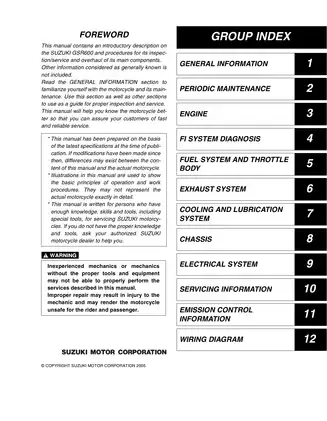
- Covers the complete chassis, FI system diagnosis, fuel system and throttle body, cooling and lubrication system, and emission control information.
Component Inspection and Maintenance Documentation
The material is structured into 12 main groups. It opens with comprehensive general information regarding fluid recommendations, identification codes, and break-in procedures. Periodic maintenance chapters detail the factory-mandated service intervals for engine oil, coolant, valve clearances, and drive chain tensioning. Engine-specific segments describe the internal assemblies. This includes the cylinder head, clutch, transmission, and crankcase components. Electrical systems, FI diagnostics, and exhaust layouts are organized into modular chapters for quick workshop reference. Instead of paying high dealership labor rates, mechanics can follow the step-by-step instructions for complex tasks like throttle valve synchronization, complete front fork overhauls, and valve clearance adjustments using the factory tappet shim selection tables. A major advantage for the daily workshop routine is the ability to bypass expensive diagnostic scanners by utilizing the manual's Dealer Mode procedures to read FI malfunction codes directly from the combination meter, which prevents inefficient trial-and-error parts swapping.
Specification Highlights and Data Preview
Spanning 480 pages, the reference provides critical data points to assist in assessing component health. Cylinder head distortion is documented with a strict 0.02 mm service limit. Intake valve clearance is specified at 0.10–0.20 mm in a cold state, while the cooling system capacity is listed at 2.8 liters. Main engine assembly torque values, such as the 100 N·m requirement for the rear axle nut, are presented in clear descriptive tables. The text also includes exploded diagrams for the transmission, clutch housing, and fuel injection systems. Beyond the standard illustrations, technicians will find diagnostic trouble code (DTC) charts, engine lubrication system charts, wire routing drawings, and periodic maintenance charts invaluable for tracing faults accurately.
Executing a successful diagnostic routine requires understanding model-specific quirks. For instance, on the K6 models, disconnecting the ECM couplers before accessing the Dealer Mode will instantly wipe the malfunction code memory, erasing crucial fault history. Furthermore, the Throttle Position (TP) and Secondary Throttle Position (STP) sensor lead wire couplers are visually identical, making them incredibly easy to swap accidentally during throttle body reassembly, which triggers immediate drivability issues. Because working on these systems involves inherent risks, this documentation is intended purely as a technical reference. Always ensure that a certified mechanic handles the actual maintenance to guarantee safe operation of the motorcycle.
Customer Reviews
Read what our customers say about this Suzuki Motorbike manual and share your own experience.