1982-1988 Honda V45/65 Sabre & Magna Owners Workshop Manual
Honda V45/65 Sabre & Magna (VF700, 750 & 1100 V-Fours) service documentation covering various models and years. Includes detailed procedures and specifications. PN 10B1-820
Manual Preview
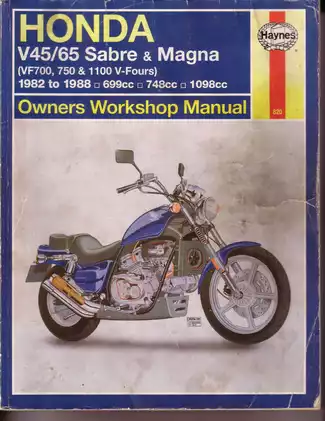
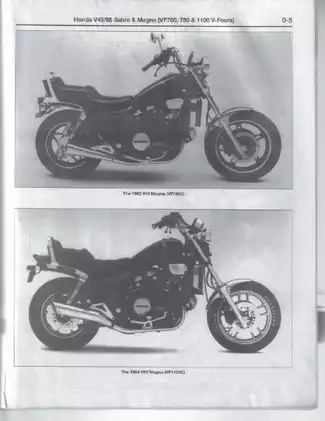
Sample pages from the 1982-1988 Honda V45/65 Sabre & Magna Owners Workshop Manual manual
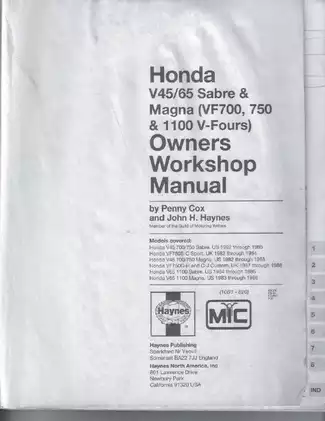
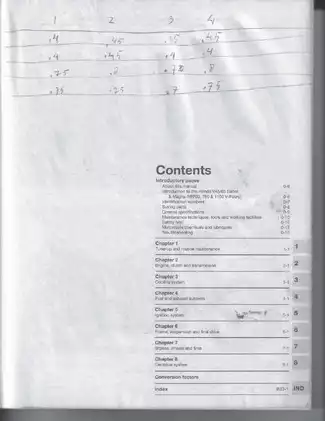
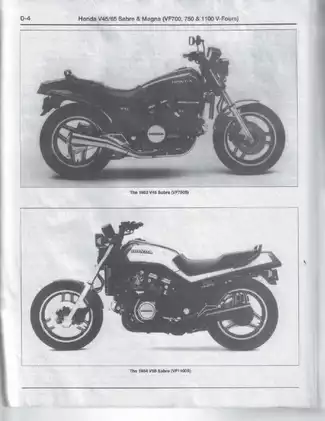
Purchase & Download
Honda Models Covered & Key Technical Specifications
Models: Honda V45 Sabre, Honda V45 Magna, Honda V65 Sabre, Honda V65 Magna
Sub-models / Variants: VF700S, VF750S, VF700C, VF750C, VF1100S, VF1100C, VF750S-C Sport, VF750C-H, VF750C-J Custom
Build Years: 1982–1988
Serial Numbers: RC07E-2000066–2304336, SC17E-2000001–2304336, RC07-2000034–2100005, RC070-CM000036–GM301306, SC170-EA100004–GM301306
Technical Data:
- Engine Displacement: 699 cc, 748 cc, 1098 cc
- Engine Configuration: 90-degree V-Four, liquid-cooled
- Compression Ratio: 10.5:1 (1982–1986), 10.2:1 (1987–1988)
- Transmission Type: 6-speed constant-mesh
- Cylinder Bore: 70 mm (700/750 models), 79.5 mm (1100 models)
- Valve Clearance: 0.12–0.15 mm (intake/exhaust, cold)
- Coolant Cap Pressure: 11–15 psi (0.76–1.04 Bars)
Honda Manual Features & Content Preview
Honda V45/V65 Sabre and Magna Technical Coverage
- Covers 1982–1988 Honda V45 and V65 V-Four motorcycles, including Sabre and Magna variants with 699cc, 748cc, and 1098cc engine displacements
- Official Haynes Owners Workshop Manual, publication number 820, published by Haynes Publishing
- Contains 47 exploded-view diagrams, 12 electrical schematics, and 34 detailed torque-setting tables
- File link appears in your order confirmation straight away
- Suitable for printing individual sections for shop-floor use
- OCR text layer lets you jump to a torque spec by keyword
- This 1994 reprint is the standard reference for the VF700, VF750, and VF1100 engine builds used in the 1980s sport-cruiser range
Detailed Technical Scope
The 1982–1988 Honda V45/V65 Sabre and Magna workshop manual documents the technical requirements for the 90-degree liquid-cooled V-Four series. Chapters provide technical details on routine maintenance, including valve clearance adjustments, fuel system servicing, and clutch hydraulics. Engine section chapters cover cylinder head removal, piston ring inspection, and transmission shaft assembly for 700cc, 750cc, and 1100cc displacements.
Cooling system data includes radiator cap pressure thresholds and thermostat specifications. The electrical chapter outlines components for starting, charging, and ignition circuits across the Sabre and Magna model years.
Specification Previews
Torque values for the 1982–1988 Honda V45/V65 series are detailed in comprehensive tables. Engine oil pan drain plug torque is specified at 35–40 Nm. Cylinder head bolt torque follows a multi-stage sequence, with final-stage values of 43–47 Nm on 700/750 models and 48–52 Nm on 1100 models. Reference how factory workshop documentation is structured for a complete breakdown of repair procedures. Spark plug gap is specified at 0.8–0.9 mm. Coolant capacity for the 1100 Magna is documented at 3.0 liters. The 1982–1988 Honda V45/V65 Sabre and Magna manual provides essential technical specifications and maintenance procedures for the 700cc, 750cc, and 1100cc V-Four engine family across all major service sections.
Manual FAQ, Purchase & Download Details
Customer Reviews
Read what our customers say about this Honda Motorcycle manual and share your own experience.