1996-2001 Hyundai Elantra Service Manual
Repair guide for all Elantra GLS, GT, Base, VE, and GL configurations. Includes tune-up, engine, cooling, fuel, emissions, electrical, and brake systems. 008-HYUNDAI
Manual Preview
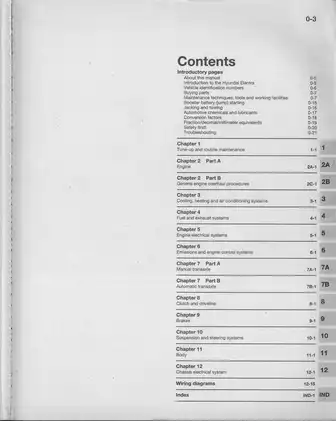
Sample pages from the 1996-2001 Hyundai Elantra Service Manual manual
Purchase & Download
Hyundai Models Covered & Key Technical Specifications
Models: Hyundai Elantra
Sub-models / Variants: Base, GL, GLS, GT, VE
Build Years: 1996–2001
Technical Data:
- Engine Displacement: 1.8L (G4GM), 2.0L (G4GF, G4GC)
- Engine Configuration: Inline 4-cylinder, DOHC 16-valve
- Transmission: 5-speed manual, 4-speed automatic
- Cooling System Capacity: 6.4 quarts (6.0 liters)
- Engine Oil Capacity: 4.5 quarts (4.2 liters)
- Spark Plug: NGK BKR5ES-11 / Champion RC10YCA (2000 and earlier), NGK PFR5N-11 / Champion RC10PYP4 (2001)
- Drive System: Front-wheel drive
Hyundai Manual Features & Content Preview
Hyundai Elantra 1996–2001 — Technical Scope and Data
- Covers the 1996–2001 Hyundai Elantra, including Base, GL, GLS, GT, and VE sedan, hatchback, and station wagon variants
- Original Haynes publication, ISBN-10: 1563924390, copyright 2001
- Features 12 chapters covering engine, fuel, cooling, transmission, electrical, and suspension systems
- Includes 84 troubleshooting flow charts to assist with common mechanical issues
- Full-text search lets you jump to a specific torque spec or part number in seconds
- Laid out for standard letter and A4 printing to facilitate shop-floor reference
- Accessible from your device as soon as the order is placed
- This 2001 edition provides the definitive OEM-style reference for the G4GM, G4GF, and G4GC engine series, including the transition to the Beta engine platform
Detailed Technical Contents
The 1996–2001 Hyundai Elantra service manual provides extensive coverage of routine maintenance, engine overhauling, and vehicle electrical diagnostics. Chapters encompass tune-up schedules, cooling and heating systems, fuel and exhaust circuits, engine electrical, emissions control, manual and automatic transaxles, and suspension/steering geometry.
Additional sections provide detailed body repair references and chassis electrical diagrams to assist in identifying components and routing. The text is structured to support both periodic service and major mechanical overhauls, with explicit guidance on torque sequences and component identification for the 1.8L and 2.0L platforms.
Reference Values and Specifications
Technical data previews include critical engine timing figures and fluid capacities. For instance, the 2001 model ignition timing is specified at 4 to 13 degrees BTDC in the specification table. The cooling system capacity for the 1996–2001 Hyundai Elantra is documented at 6.4 quarts. Furthermore, the what an OEM service publication covers includes detailed bolt strength markings and metric-to-standard conversion tables for general hardware repair.
Note: All service data shown here is for reference only — qualified technicians and the original manufacturer documentation remain the authoritative source for any hands-on work. An official 1996–2001 Hyundai Elantra repair manual documenting comprehensive engine, chassis, and electrical specifications for the G4-series engine family.
Manual FAQ, Purchase & Download Details
Customer Reviews
Read what our customers say about this Hyundai Car manual and share your own experience.