Not every tractor buyer arrives with the same level of certainty. Some already have the exact model on the hood, the series on the tag, and a clear idea of the document they need. Others only know the brand, or they know the tractor is “older,” “compact,” or “somewhere in the utility range.” That is why the tractor section on RepairLoader is useful as a starting point. It gives shoppers a wider field first, which is often the easiest way to avoid locking onto the wrong manual too early.
This matters because tractor documentation is rarely one-size-fits-all. On these pages, buyers are not just choosing between brands. They are sorting through compact tractors, utility tractors, older farm tractors, garden-tractor platforms, grouped series manuals, and narrower model-specific files. A listing that fits a Ford 8N buyer is a completely different kind of choice from a grouped Kubota B-series manual or a multi-model Yanmar shop manual. The broader tractor page helps make that visible before the search becomes too narrow.
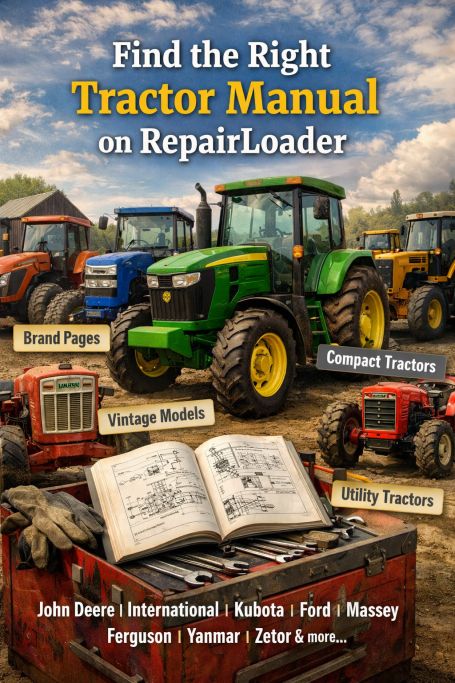
A practical way to use the category is this: start broad if you are still identifying the machine, and go directly to a brand or product page if the exact model is already known. The main tractor category works best for that first broad step. It is the place to begin when you want to compare brands, see how different tractor families are grouped, and decide whether you should continue into a brand page or skip straight to a model-specific manual.
That distinction becomes important quickly, because the linked brand pages are not all equally useful in the same way. Some work as active browsing pages with visible inventory and clear selection hints. Others are better treated as supporting references because they currently do not show live results on the URLs listed here. The John Deere, New Holland, and Cub Cadet pages currently do not function as strong browsing destinations on their own. For a shopper, that means one simple thing: use the main tractor page or jump directly to the matching product page when you already know the tractor family.
The pages that do carry visible content are much more useful for selection. The International section is a solid place to continue when the buyer is comparing older International Harvester families and needs to separate one grouped tractor line from another. The Kubota page is helpful for compact tractor shoppers, especially where the difference between nearby B-series models matters more than the Kubota name by itself. The Ford page is stronger for model-first shopping, where the exact numeric identity is the key buying signal.
Several of the other brand pages are useful because they help narrow by tractor type rather than brand alone. The Bolens page is relevant for buyers in the smaller diesel and garden-tractor area, where grouped model codes can be more important than the front badge. The Ariens page works well when the numbering itself is the main clue. The Massey Ferguson page is especially useful when a shopper wants to compare variant-heavy listings and look for extras such as addenda or diagrams before buying. The Case page helps when the machine sits in a broader Case or Case IH family and the buyer needs context before choosing a product page.
The same pattern continues across the remaining brands. The Yanmar page is strong for grouped compact tractor families. The Oliver page is useful for vintage tractor shoppers who need a cleaner path through older model names. The Zetor page helps when exact designation and grouped workshop coverage matter. The Kioti page is practical when the buyer wants to compare a few nearby listings and pay attention to suffixes, transmission variants, or preview cues before deciding.
The product pages are where this becomes even easier to understand. The John Deere 5105 / 5205 Technical Manual TM1792 is a good choice when the buyer already knows the tractor sits in that exact two-model family and wants a technical reference tied to those tractors instead of a broad John Deere search. The International Harvester 706-21456 series shop manual is a grouped older-series example, useful when the tractor belongs to that family and the value lies in the coverage range rather than one single model. The Kubota B2320 / B2620 / B2920 service manual is the kind of listing that works best when the buyer is already sure they are shopping inside that B-series cluster.
Some of the linked manuals are especially strong because the model identity is very narrow. The Ford 8N service manual is a classic example. A buyer searching for an 8N does not need a broad Ford overview first. They need a page that clearly reflects that exact tractor. The Massey Ferguson GC2300 manual works in a similar way for compact-tractor buyers who already know the exact machine. The Oliver / Cockshutt 1550 shop manual is another narrow-match case where the buyer benefits from going straight to the product page instead of browsing by brand.
Other linked manuals are useful because they show how grouped coverage can be the better fit. The New Holland 345D / 445D / 545D / 250C / 260C manual is one of those broader grouped-family manuals, where the buyer should check whether the tractor falls inside that exact range before assuming it will fit. The Yanmar YM135 / YM155 / YM195 / YM240 / YM330 shop manual does the same thing for compact Yanmar families. The Zetor 8011 / 8045 / 12011 / 12045 workshop manual is another strong example of grouped workshop coverage, and it works best when the model group is already known.
A few of the linked pages are also especially useful for buyers who need to watch suffixes and series details closely. The Kioti CK25 / CK30 / CK25H / CK30H workshop manual makes that point clearly, because the hydrostatic variants and model suffixes matter. The Case IH / International Harvester 856 XL service manual is helpful when the buyer is already beyond the broad International stage and needs a tighter Case-IH-era match. The Ariens 931 Series garden tractor manual and Cub Cadet 7000 Series compact tractor service manual are useful reminders that even when a brand page is thin or empty, a direct model-series product page can still be the fastest route to the right document.
For a buyer, the most useful question is not “Which brand page should I read first?” but “What is the best starting point for how certain I already am?” If the exact tractor model is already known, a direct product page is often the smartest move. If the buyer is still sorting out whether the tractor is in a grouped family, an active brand page like International, Kubota, Ford, Massey Ferguson, Case, Yanmar, Oliver, Zetor, or Kioti is the better next step. And if the search is still wide open, the main tractor category remains the best place to begin.
One final advantage of using the pages this way is that it lowers the chance of a wrong purchase. The safest pattern is simple: trust the full model code over the brand alone, pay attention to grouped ranges, do not ignore suffixes or series letters, and check whether the listing is a technical, service, shop, or workshop manual rather than assuming every tractor manual does the same job. On a site with a broad tractor inventory, that kind of structure is exactly what helps shoppers make a faster and better decision.
For a RepairLoader blog post, that is the real message worth highlighting. These pages are not just there to hold download links. They give tractor buyers several practical ways to narrow the search: broad category when they need orientation, active brand pages when they want model-family context, and direct product pages when they already know the exact tractor they are matching. That makes the shop more useful not only as a catalog, but as a real decision tool for choosing the right manual.