Finding the right gasoline engine manual is often harder than it looks because the safest match is rarely the broad brand name alone. A buyer may need to sort by engine family, displacement, year, platform, application type, or even whether the listing is a service manual, a workshop manual, or a parts catalog. That is exactly why the RepairLoader gasoline engines category works best as a starting page for comparison rather than a place to make a rushed purchase. It gives users a broader view of the inventory first, with dozens of listings across very different engine types and use cases
What makes this category useful is the range it covers. The visible section is not limited to one market segment. It includes motorcycle engines, utility engines, mower and industrial-style engines, marine gasoline engines, PWC-related entries, and model-specific workshop or parts documentation. That matters because it helps users understand a core buying reality: “gasoline engine manual” is not one document type or one product family. It is a broad category that only becomes useful once the buyer identifies the right selection signal. On some listings that signal is the model code. On others it is the engine family, the year span, or the machine platform the engine belongs to.
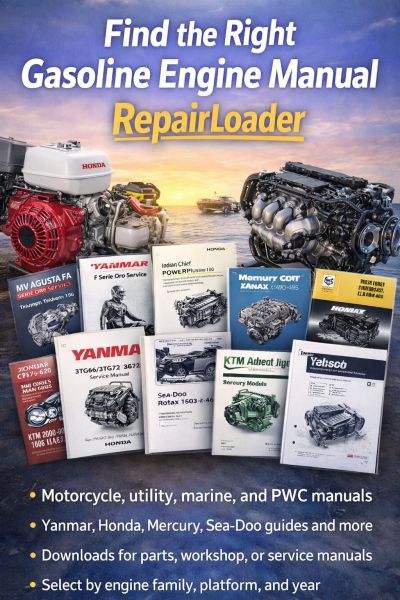
A good way to use the main category page is to start there when you still need orientation. If you know you need gasoline-engine documentation but are not yet sure whether your best match is a narrow parts book, a full service manual, or a machine-platform manual that includes the engine, the category page is the right first stop. It helps users compare scope before drilling into one product page. That is especially helpful when two listings may both sound correct but are grouped around different identifiers.
The linked product pages show exactly why this matters. Some are extremely tight and model-driven. The Yanmar 3TG66/3TG72 manual is built around a very specific gasoline engine family, making it a better fit for buyers who already know they are inside that exact 3TG66/3TG72 range. The Honda G65/G80 engine manual is similarly focused and makes sense when the engine series itself is the clearest identifier. The same model-first logic applies to the Honda GC160 manual, the Kohler CV11-16 / CV460-465 / CV490-495 manual, and the Honda GX610 / GX620 parts catalog. These are the kinds of listings where a precise engine code is more important than the machine the engine happens to power.
Other product pages work better when the platform matters as much as the engine. The 2005 Sea-Doo Rotax 1503 4-TEC shop manual is a good example because the engine sits inside a specific Sea-Doo application context. The Mercury 200 OptiMax Jet Drive service manual also shows this pattern clearly: the right match depends not only on the engine name, but on the jet-drive application and year. In these cases, buyers should not stop at “Rotax” or “Mercury” alone. The exact machine context is part of the buying decision.
Some listings are broader and therefore useful in a different way. The KTM 2000-2006 engine manual spans multiple engine sizes and model groups, which makes it useful when a buyer is comparing several nearby KTM possibilities and wants one broader technical reference. The John Deere K Series engine manual similarly makes sense when the engine family is tied to a known mower-engine line rather than one narrow standalone code. Broader manuals can be excellent value, but they also require more care. A wider year range or larger model list is not automatically better if a narrower manual names the exact engine more clearly.
The older and enthusiast-focused listings show another reason the category is useful. The MV Agusta F4 Serie Oro engine service manual, the Triumph Trident T150 service manual, and the Indian Chief PowerPlus 100 manual are not generic engine downloads. They are tightly tied to specific vintage or performance-oriented applications where naming overlap and historical variation can easily lead to a wrong assumption. These pages are most useful when the buyer already has a strong identification anchor and wants a listing that reflects that exact machine or engine context.
The Rotax 400 engine service manual is another good example of why document type matters. Buyers who need assemblies, parts relationship context, or a focused service reference can get much more from a clearly identified Rotax 400 listing than from a broad search across all Rotax-related products. The page works best when the user is already confident about the engine family and wants to confirm a direct match rather than browse loosely.
A practical way to avoid the wrong purchase on these pages is to let the title wording do more work. If the listing says “parts catalog,” that usually points to exploded views and parts identification rather than a full workshop-style service reference. If it says “service manual” or “shop manual,” it usually signals broader technical coverage. If it includes a very specific engine code, that code is often the strongest decision signal on the page. If it includes a wider model family or a longer year range, that tells you the file may be more general and should be checked more carefully against your exact engine. On RepairLoader, those small wording differences are often more useful than a broad product label like “gasoline engine manual.”
Another practical tip is to compare scope before price. A cheaper manual is not the better buy if the title stays vague while another listing names the exact engine family, year, or platform much more clearly. This is especially important in a mixed category like gasoline engines, where one buyer may need a compact utility-engine manual, another may need a motorcycle engine reference, and another may need a marine or PWC-related service file. The category page is useful because it encourages that comparison first, instead of pushing every buyer into the same type of document. :contentReference[oaicite:10]{index=10}
What users will find on RepairLoader’s gasoline-engine pages, then, is not just a large set of PDFs, but a better path to choosing them. The main gasoline engines category is where to start when you need orientation across different engine families and document types. More focused pages like the Yanmar 3TG66/3TG72 manual, Honda G65/G80 manual, Honda GC160 manual, or Kohler CV series manual are better when the engine code is already known. Platform-linked listings like the Sea-Doo Rotax 1503 4-TEC manual and Mercury 200 OptiMax Jet Drive manual are better when the machine context is part of the match. Broader references like the KTM multi-engine manual help when the buyer is still comparing several nearby possibilities.
That is what makes this section useful for shoppers. It is not only a category page with downloadable manuals. It is a practical selection path built around real decision signals: exact engine code, platform context, year band, and document type. For buyers who want to avoid vague results and choose a manual with more confidence, RepairLoader’s gasoline engines section gives them a much better place to start.