Cessna Aircraft Service Manuals & Illustrated Parts Catalogs
Get immediate access to professional-grade technical documentation for Cessna single-engine and multi-engine aircraft. Our digital collection provides Airframe and Powerplant (A&P) mechanics, avionics technicians, and aircraft owners with the exact OEM data required for annual inspections, major overhauls, and strict FAA compliance.
Aviation Maintenance Safety & Regulatory Notice: These technical archives are specifically curated for licensed Airframe and Powerplant (A&P) technicians and qualified aviation maintenance providers. Executing repairs on flight control surfaces, fuel injection systems, or structural components involves critical safety-of-flight risks. By utilizing these resources, you acknowledge that RepairLoader provides original engineering data solely for informational and reference purposes. Always prioritize flight safety: adhere to current FAA/EASA airworthiness directives (ADs) and consult a factory-authorized service center if a procedure exceeds your certification or tooling capabilities.
Authentic Factory Manuals & Original OEM Data
In aviation maintenance, the accuracy of your source material directly dictates aircraft longevity and pilot safety. To ensure total reliability and FAA compliance, our Cessna library consists of high-resolution, exact digital reproductions of the original factory manuals. Unlike generic third-party guides that often miss year-specific rigging nuances or updated inspection cycles, these digital volumes are 1:1 copies of the engineering data originally published by the Cessna Aircraft Company in Wichita, Kansas.
Get the Exact Data for Your Specific Airframe
Relying on "approximate" reference material is a critical hazard. While Cessna airframes may look identical on the ramp, they undergo significant structural and systemic changes across production years. We organize our library by specific serial numbers and series prefixes so you can find the exact manual for your tail number.
Our repository is built exclusively on primary-source manufacturer technical publications:
- Model-Specific Airframe Data: Access precise documentation for the 172 Skyhawk family (from early 1956 models to modern fuel-injected 172R/172S platforms), complex singles like the 177RG/210 Centurion, and foundational trainers like the 150/152 series.
- OEM Specifications: Every critical metric—from flight control cable tensions and landing gear shimmy damper tolerances to exact engine mount torque values—is presented exactly as recorded in the manufacturer's original reference files.
- Guaranteed Diagnostic Clarity: We verify every PDF to ensure intricate electrical schematics (ETM), fuel routing maps, and exploded component views remain perfectly legible and usable right on the hangar floor.
Service Manuals vs. Illustrated Parts Catalogs (IPCs)
Safe, legal repairs typically require both document types. We provide both in high-resolution digital formats:
- Service & Maintenance Manuals: Your primary step-by-step guide for maintenance procedures. These documents outline required torque limits, flight control rigging, component rebuilds, and electrical system troubleshooting.
- Illustrated Parts Catalogs (IPCs): Essential for accurate assembly and legal compliance. Featuring detailed exploded views, IPCs allow you to identify correct OEM part numbers, verify hardware placement (like washers and cotter pins), and confirm approved parts substitutions.
Instant PDF Downloads for A&Ps and Owners
Waiting days for physical manuals delays critical maintenance. If you are diagnosing a magneto drop on the tarmac or re-skinning an elevator in the shop, you need information now. Each manual is delivered instantly as a fully searchable PDF. Download the documentation to your tablet or laptop, cross-reference part numbers on the spot, and get your aircraft back on the flight line safely.
Cessna Manuals (25 total results)
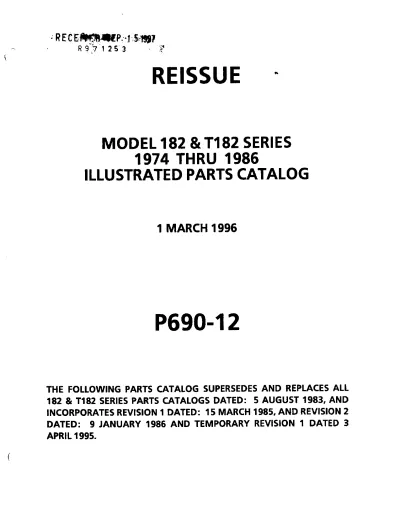
1974–1986 Cessna 182 & T182 Illustrated Parts Catalog (P/N P690-12)
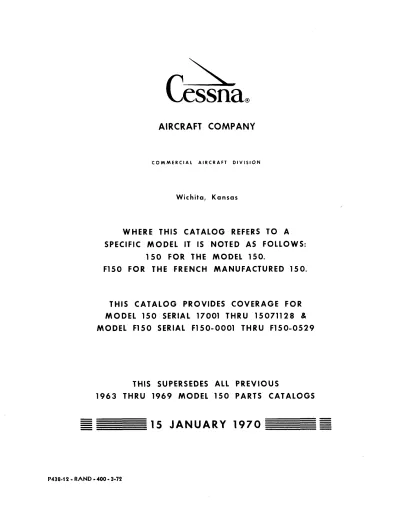
1963–1969 Cessna 150 Illustrated Parts Catalog (P/N P438-12)
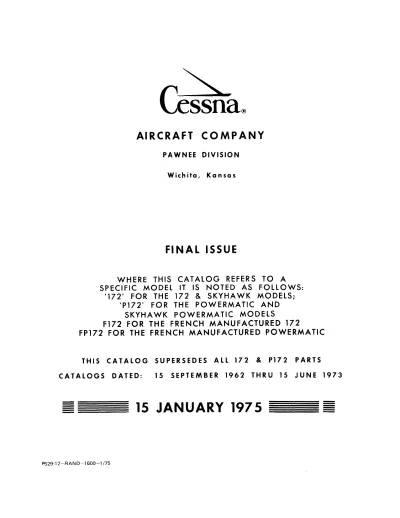
Cessna 172, Skyhawk, P172 Aircraft 1963–1975 Illustrated Parts Catalog (P/N P529-12)
1977–1981 Cessna R172K Hawk XP & FR172K Hawk XP Series Illustrated Parts Catalog
1969–1976 Cessna Skywagon 180/185 & AGcarryall Service Manual (P/N D2000C4-13)
1980–1985 Cessna 172RG Cutlass RG / RG II Illustrated Parts Catalog (P/N P693-12-RGI-100-6/97)
1971–1976 Cessna 177RG Illustrated Parts Catalog (P/N P535-12-RAND-1000–10/75)
1956–1962 Cessna 172 / 175 Illustrated Parts Catalog
1977–1986 Cessna 172 N Skyhawk Factory Service Manual (P/N D2065-3-13)
Cessna 172 Service Manual (1996 & On) 172R and 172S Skyhawk SP (P/N 172RMM15)
1963–1968 Cessna 100-Series Aircraft Service Manual – 150, 172, P172, 180, 182, 185 & A185 (P/N D637-13)
1969–1976 Cessna 150 Series Service Manual (P/N D971C3-RAND-1600-7/75)
1975–1986 Cessna Aircraft Model 172 Illustrated Parts Catalog (P/N P696-12)
Cessna 340/340A 1971–2009 Installation Instruction and Service Manual OEM (P/N 34-010-61M)
1969–1976 Cessna 172K/L/M, Skyhawk, Skyhawk II & Reims F172 OEM Service Manual (P/N D972-13)
1971–1975 Cessna 177RG Cardinal RG Aircraft Service Manual (P/N D991-13)
1968–1975 Cessna Model 177, Cardinal, and Cardinal II Illustrated Parts Catalog Aircraft (P/N P532-12-RAND-1500-7/75)
1977 Cessna 172N / Reims F172N Skyhawk Aircraft Factory Service Manual (P/N D2012-13-RAND-1300-7/76)
Cessna Cessna 172, Skyhawk, P172 Powermatic, and French F172/FP172 1963–1974 Parts Catalog (P/N P529-12)
1970–1976 Cessna 210K, T210K, 210L & T210L Centurion Aircraft Service Manual (P/N D2004-13-RAND-350-2/76)
Cessna 152 Series (152, F152, A152) 1978–1985 Aircraft Service Manual (P/N D2064-1-13)
Cessna 210K / T210K / 210L / T210L Illustrated Parts Catalog 1974 (P/N P523-12-RAND-1000–10/74)
1953–1962 Cessna 150, 172, 175, 180, 182, and 185 Series Skyhawk, Skylark, Skylane, Skywagon Single-Engine Aircraft Service Manual (P/N D-138-13-GRIT-1500-2/1/62)
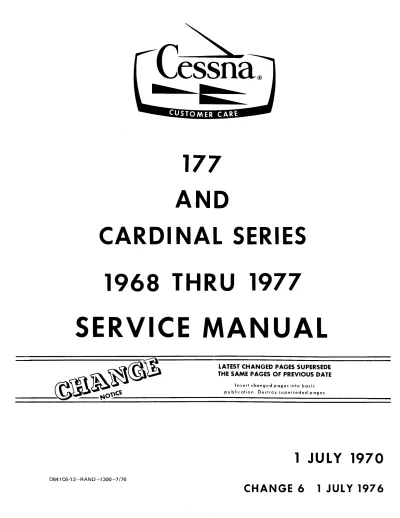
1968–1977 Cessna 177, 177A, 177B Cardinal, Cardinal II and Cardinal RG Series Airplane Service & Repair Manual (First Edition)